-
CBeeD’s efforts are helping to rejuvenate the age-old traditional occupation of tribal people, which offers them a sustainable seasonal livelihood.
-
There is an availability of non-violent forest honey in the market.
-
Consumers are enjoying the highest quality therapeutic natural organic honey.
-
Thousands of forest bees are being saved to retain the most vital service of cross-pollination in nature.
-
The conservation of rock bee populations is bringing prosperity to ecology through the revival of the process of cross-pollination.
-
Overall, activities are being implemented by CBeeD in various rock bee-rich pockets under the socio-welfare schemes of the state, central government, and CSR partnerships.
About 'Sewagram Nisarg Honey'
Apis dorsata - the source of 'Sewagram Nisarg Honey'
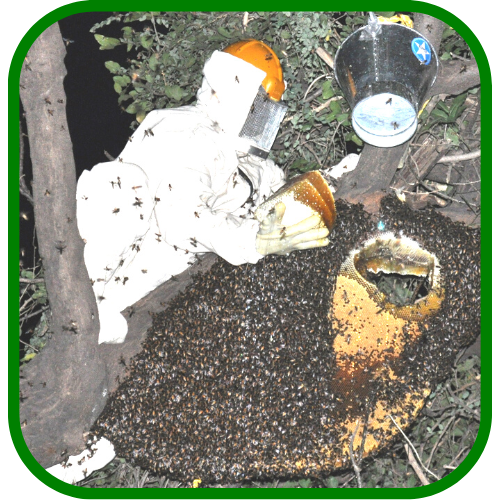
It is the much-known forest bee variety, scientifically called Apis dorsata. It is also commonly referred to as the rock bee. It naturally appears in the plains and forest areas as per the flowering seasons of native vegetation. It is the prime-prolific pollinator, and it is mainly responsible for food productivity and diversity in nature. In other words, due to the process of sustained bee-pollination, the overall productivity of the crops and forest vegetation is enhanced multifold. Besides, Apis dorsata is also the prime resource of forest honey, made of nectar and pollen gathered by them from the uncontaminated flowers. Thus, by default, the forest honey obtained is organic in a true sense.
CBeeD's intervention in SNTRM
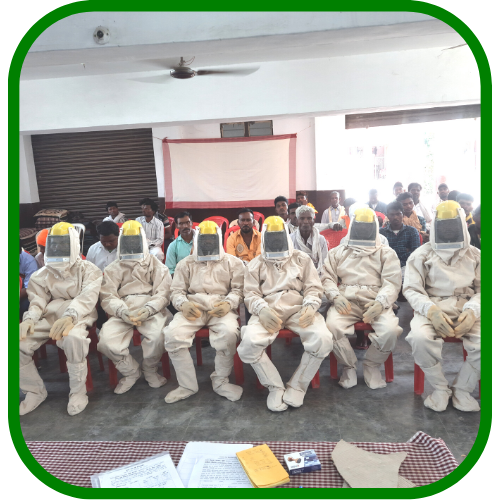
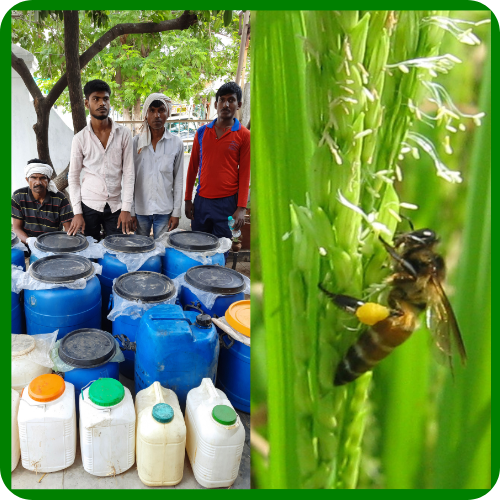
To ensure bee-friendly honey collection, CBeeD uses its non-violent technique, Sewagram Nisarg Technology of Rock bee Management (SNTRM). Youths from tribal communities who traditionally hunt honey have been given the necessary training module to disseminate SNTRM. This module has been practiced in about 29 districts in India for the last 23 years through local NGOs and small businesses. The trained honey collectors are equipped with necessary gear like sting protective dresses, ropes, rope ladders, buckets, tubs, torches, knives, containers, strainers, etc.
Social enterprise for forest honey
The production of honey and wax is undertaken by these trained tribal families, which is immediately purchased with the fare prices. The buyback arrangement is saving these primary honey producers from possible exploitation at the hands of local traders.
The local agencies that are involved in buy-back arrangements of forest honey are encouraged further to establish low-cost facilities for honey-wax storage, processing, quality control, packaging, and market promotion. The processed, filtered, and packed honey is sold in an open market in retail or bulk, and thus, the backward-forward linkages of marketing are established to revive the forest honey-based social enterprise.
CBeeD’s intervention & benefits
Venture supported by
One such very successful experiment on bee-friendly management (SNTRM) of rock bees has been implemented in the Vidharba region of Maharashtra State by CBeeD in the past 23 years through the projects supported by DRDA (Govt. of MS); CAPART (N. Delhi, Govt. of India); Tribal Department (Govt. of MS); DST (Govt. of India); NABARD (UPNRM); Pune, Mission Samriddhi, Chennai; and ICICI Bank Foundation, Mumbai. Nearly 160 trained honey collectors actively collect over 15 tons of wild honey per annum. CBeeD has facilities for its storage, processing, quality estimation, and packaging. The processed honey is being marketed under the brand name ‘Sewagram Nisarg Honey’ which is certified under Grade ‘A’ by AGMARK (CA No. A/1 006507) and is sold under the FSSAI license No. 11518057000002.
